AboutTAxT
About TAxT – Taoyuan Art x Technology Festival
Taoyuan City is Taiwan’s leading industrial and technological hub and has been ranked as the #1 smart city in international evaluations. With its unique environment combining culture and technology, the Taoyuan City Government launched the TAxT – Taoyuan Art x Technology Festival in 2017 to develop a cultural-tech city. The festival integrates multiple goals, including internationalization, local engagement, campus cultivation, and industry collaboration.
Since 2019, the festival has further introduced the Taoyuan Tech Performing Arts Award to discover and nurture talent at the intersection of technology and performing arts. TAxT is currently one of the few large-scale tech-art festivals in Taiwan organized by a local government and has become an important platform for cross-disciplinary exchange between technology and the arts.
Director’s Preface
Hybrid Evolution · Future Life New Type
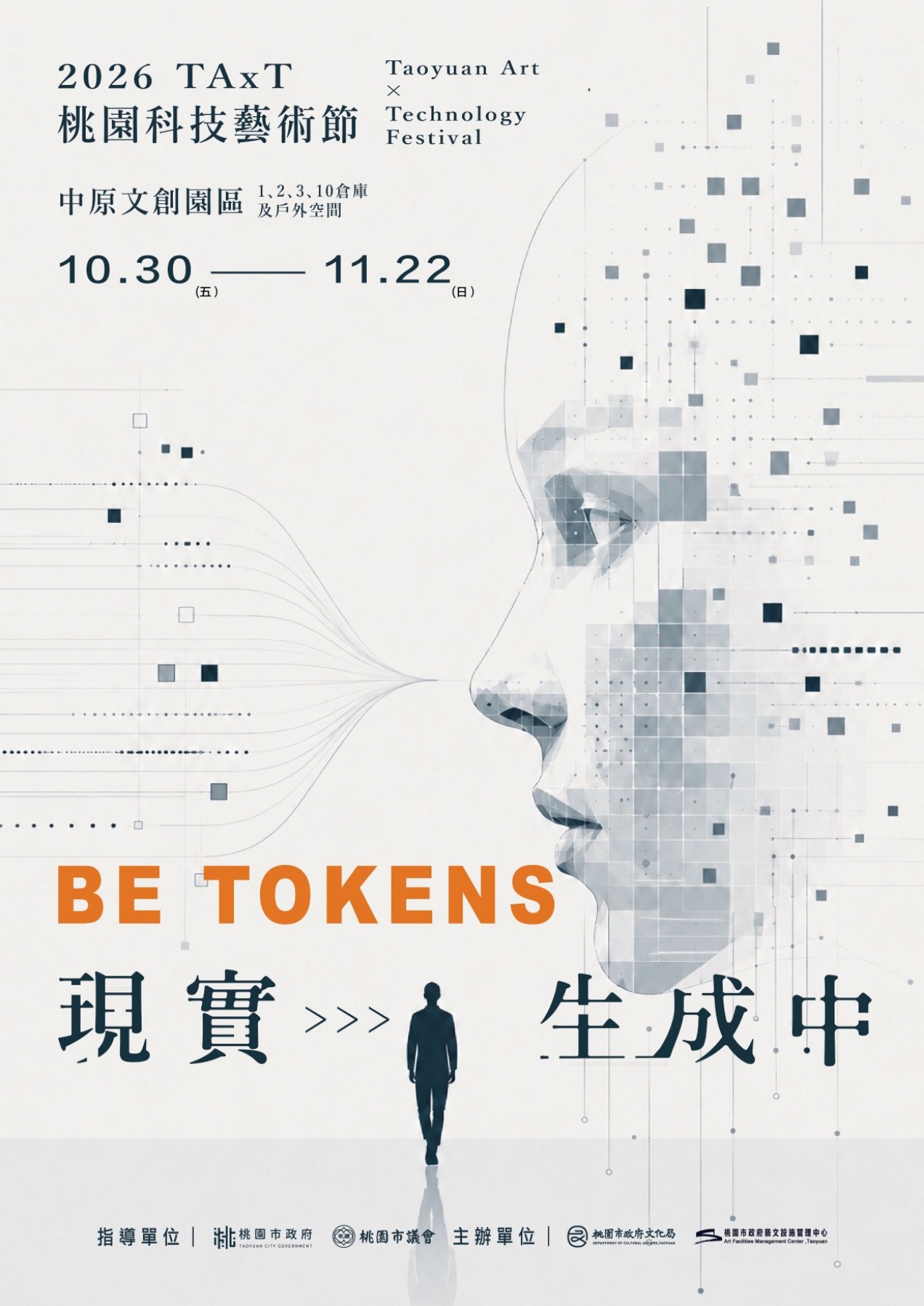
This year, the exhibition takes a cue from “token,” the fundamental unit of generative AI. Before entering an AI model, text is often broken down into computational fragments, then new content is generated through predictive recombination. The curatorial team takes this concept a step further and proposes the question: if language can be broken down into tokens, are human bodies, memories, sentiments, and actions also gradually becoming data that can be read and reborn? Through three sub-themes—“Co-habitation,” “Co-creation,” and “Co-articulation” —the exhibition intends to explore how AI enters everyday life, participates in creational process, and establishes new communication modes. The “Co-habitation” section focuses on how technology steps into the daily lives of humans and nature. “Habitat of Sound #2: Artificial Habitat” takes the Taoyuan coast and little tern conservation as clues, where viewers’ approaching would cause bird calls to experience delayed distortion, and transforms interaction into an environmental disturbance; “Eye of the Swarm” by Hu Chin-Shiang and Kuro Art Lab constructs a collective sensory field applying AI imagery, power plant, and skeleton tracking; French collective hellobastworkshop’s “AURA” transforms visitors into unique colors and lights, and their halos overlap upon meeting; “Walking Appendage” reflects on human’s dependence on digital tools through outdoor animal sculptures and a QR code game. The “Co-creation” section departs from dreams, land, healthcare, and perception. ULTRACOMBOS’s “40Hz (V2)” draws on the imagery of Peter Pan chasing his shadow and the concept of lucid dreaming, feeding dreams into an AI to form a “collective dream pool”; “One Hundred Faces of Water” combines Taoyuan water conservancy, rice paddy landscapes, and real-time rendering, allowing footsteps to alter projected water ripples; “The Symmetrical Hallucinations: A Medical Mirror” and German artist Adrian Dittert’s “Fragments of Perception” question how technology restructures the ways we understand our bodies and the world. The “Co-articulation” section examines the relationship between AI, human language, and creation. “#5480 Times of South Breeze: An Unfinished Genetic Code” uses real family letters as a corpus, with AI generating text and mechanical writing leaving ink marks; “Artificial Intelligence and Artificial Intelligence are in Conversation,” a collaboration between LUO LAB from Tainan National University of the Arts and Ando LAB from Osaka University of the Arts, enables two AIs to converse through robotic arms. Bianca Lei’s “Artificial Iteration (AI)” shifts between AI-generated imagery, physical painting, and digital translation, questioning the boundaries between the creator and the original work.